
Global Economy
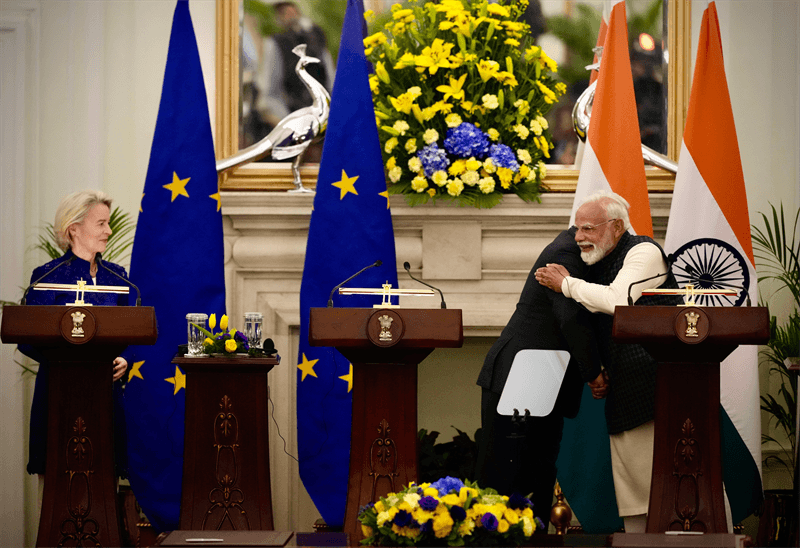
EU and India Seal Historic Free‑Trade Deal Covering 96% of Goods
The European Union and India announced on Tuesday the conclusion of a landmark free‑trade agreement that will eliminate tariffs on more than 96 % of EU‑exported goods entering India and on 99.5 % of Indian products heading to the EU. The pact, finalised after two decades of negotiations, aims to double EU exports to the 1.4 billion‑person Indian market by 2032 and to diversify trade away from the volatility of U.S. tariffs under the Trump administration. The agreement will immediately remove duties on seafood, leather, textiles, chemicals, rubber, base metals and jewelry, while excluding beef, rice, soy and dairy. Full legal ratification is expected within six months, with the deal slated to come into force next year.
Listen to this article
Unlock audio versions of premium articles and more with a Pro subscription.
Background and Scope
The European Union and India announced on Tuesday that they have reached a comprehensive free‑trade agreement after twenty years of negotiations. The deal will eliminate or heavily reduce tariffs on more than 96 % of EU‑exported goods destined for the Indian market and on 99.5 % of Indian products entering the EU.
Key Tariff Reductions
- All duties on seafood, leather, textiles, chemicals, rubber, base metals and jewelry will be removed.
- Tariffs on beef, rice, soy and dairy products remain excluded from the agreement.
- India will cut its automobile duties from the current 110 % to a maximum of 10 % over the next five years.
- Indian wine and other alcoholic beverages will see an immediate 50 % cut (from 150 % to 75 %), with a gradual reduction to 20 %.
Strategic Rationale
The pact is positioned as a hedge against the erratic trade policies of the United States under former President Donald Trump, who imposed high tariffs on a range of imported goods, including a 50 % surcharge on Indian products. By deepening EU‑India ties, both parties aim to diversify supply chains and reduce reliance on the U.S. market.
Economic Impact
Brussels projects that EU exports to India could double by 2032, tapping a consumer base of 1.4 billion people. Trade between the EU and India reached USD 136.5 billion (EUR 116.3 billion) in the 2024/25 fiscal year, slightly ahead of India‑U.S. trade (USD 132 billion) and India‑China trade (USD 128 billion).
Implementation Timeline
The agreement will undergo a legal review lasting about six months before formal signing. Both sides expect the treaty to be ratified and effective within the next year. Some EU members may raise objections, echoing the challenges faced by the EU‑Mercosur deal.
Broader Trade Landscape
The EU has recently concluded free‑trade deals with Mercosur, Indonesia, Mexico and Switzerland, while India has sealed agreements with the United Kingdom, New Zealand and Oman. These moves reflect a broader global trend of medium‑sized economies seeking alternatives to U.S. trade pressure.
Source: Reuters.