
Stocks Market
Oil Prices Rise Amid Ongoing Uncertainty Over Hormuz Strait Reopening
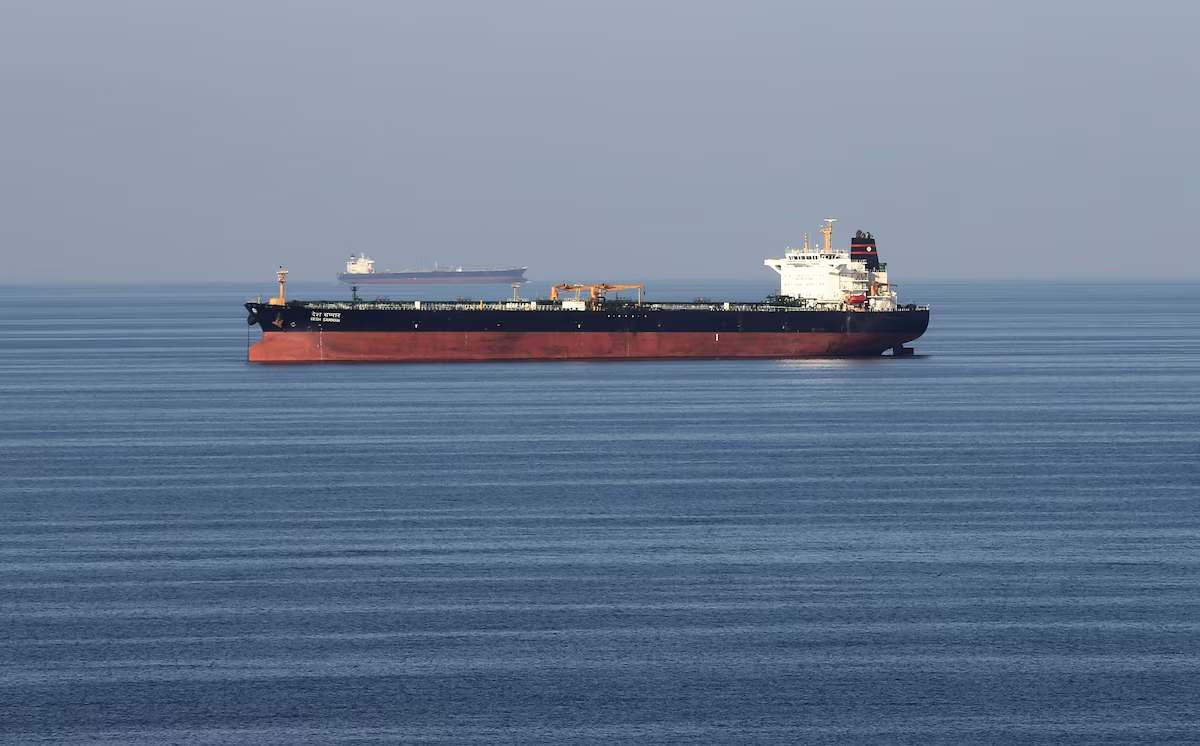
Oil markets kept climbing on Friday as fresh doubts over how the Strait of Hormuz will be reopened kept the market on edge. Iran’s parliament is drafting a law that could block U.S., Israeli and other “hostile” vessels and impose hefty fines and passage fees, while the United States opposes any new tolls. These geopolitical frictions, together with recent Houthi attacks in the Red Sea region, have pushed Brent up $0.85 to $83.34 and WTI up $0.52 to $77.81, extending Thursday’s rebound but still leaving both benchmarks on track for an roughly 8 % weekly decline. The article underscores the strategic importance of Hormuz – a conduit for about 20 % of the world’s oil and LNG – and highlights how sanctions, insurance clauses and payment restrictions could make any new regime difficult to enforce.
Listen to this article
Unlock audio versions of premium articles and more with a Pro subscription.
Market Snapshot
At 06:34 GMT, Brent crude slipped up by $0.85, or 1.03 %, to $83.34 per barrel, while the U.S. West Texas Intermediate (WTI) rose $0.52, or 0.67 %, to $77.81.
The move extends Thursday’s rebound, when both benchmarks closed more than $3 higher. Earlier in the week, prices had fallen as hopes rose for a resolution to the regional conflict, briefly pushing Brent below the $80 mark – a level not seen since 13 July.
Despite the current uptick, both Brent and WTI are still on track for an approximately 8 % weekly decline.
Key Drivers of the Recent Rally
- Uncertainty over the reopening of the Strait of Hormuz. Iran’s parliament is reviewing a draft law that could bar U.S., Israeli and “hostile” vessels from the strait.
- Potential penalties and fees. The proposal outlines fines up to 20 % of cargo value for violations and suggests passage fees of 5‑7 % of the cargo’s worth – Tehran has hinted at a 5‑7 % levy, while Oman is eyeing around 3 %.
- U.S. opposition. Washington firmly opposes any new tolls, adding to doubts about the practical rollout of the regime.
- Implementation challenges. Four maritime‑industry sources say sanctions, insurance clauses and payment restrictions could make enforcement difficult.
Strategic Importance of the Strait
Before the February‑end war, the Hormuz corridor carried roughly one‑fifth of the world’s oil and liquefied natural gas shipments. Any disruption can quickly reverberate through global energy prices.
Geopolitical Context
In parallel, Yemen’s Houthi rebels claimed missile and drone attacks on Saudi positions in Marib and Hadramaout. The same day, former U.S. President Donald Trump suggested the war could end soon – a statement that adds to market volatility.
Source: Reuters.